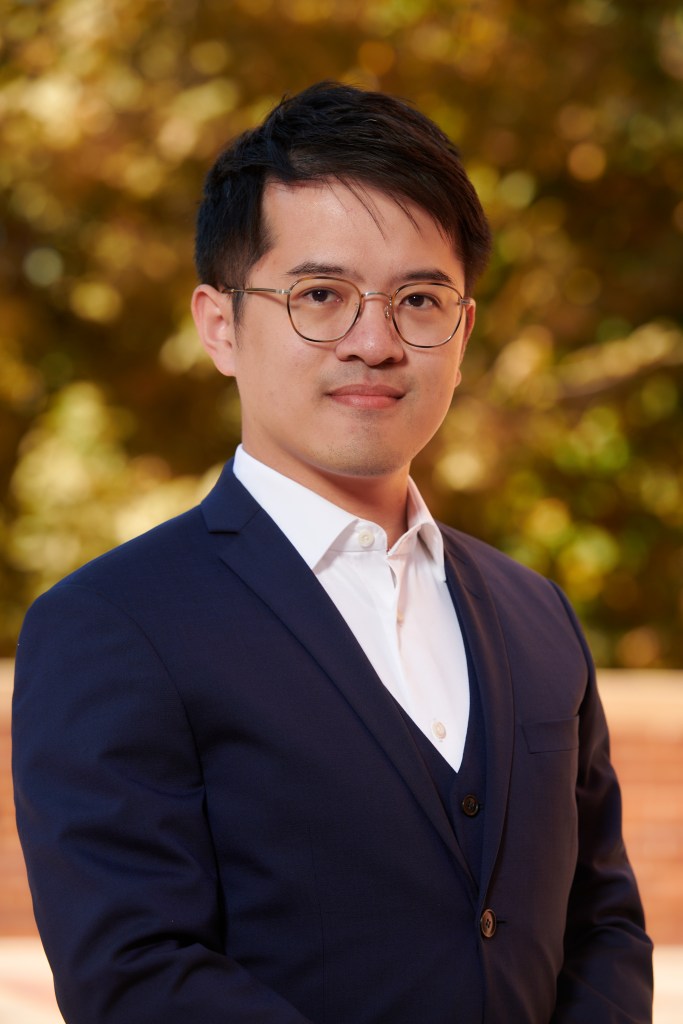
Kai Chiu Yang
Ph.D. Candidate, Accounting
UCLA Anderson School of Management
110 Westwood Plaza
Los Angeles, CA 90095
Ph.D. in Accounting, UCLA, 2027 (expected)
M.A. in Economics, University of Zurich, 2022
B.B.A. in Accounting, Peking University, 2016
Certified Public Accountant – Washington State
Welcome!
I am Kai, a Ph.D. Candidate in Accounting at Anderson School of Management, University of California – Los Angeles (UCLA). I expect to graduate in 2027 and will be on the 2026-2027 academic job market.
My research studies how information and incentives shape economic decisions within firms and capital markets, with current projects on credit ratings, financial intermediaries, goodwill accounting, and corporate governance. I use analytical models in my research, and employ archival evidence and structural estimation to evaluate the models.
Before my Ph.D., I earned an M.A. in Economics from the University of Zurich and a B.B.A. in Accounting from Guanghua School of Management at Peking University. I am also an active CPA with experience in finance and strategy roles in the technology and consumer electronics industries.
Outside of academics, I enjoy hiking, photography, and spending time with my dog.
Feel free to reach out at kaichiuyang@g.ucla.edu!
Research
[1] Intermediated Classification (solo authored, job market paper)
Abstract
This paper studies how a privately informed sender communicates through an intermediary that classifies the sender into discrete categories (e.g., ratings, tiers, or labels). This discrete structure can restrain strategic misreporting, and accurate implementation of a classification standard is possible only when it uses a small number of categories. Pursuing accuracy, however, comes at a cost, since finer classifications may convey more information by tolerating some misclassification. In a general design problem with an endogenous standard, every classification pools a nondegenerate interval of top types, which places an upper bound on the informativeness attainable for any classification.
- Dissertation Committee: Beatrice Michaeli (Chair), Judson Caskey, Henry Friedman, Alexander Bloedel
- Presented at: UCLA, 38th Olin Accounting Research Conference (WUSTL, scheduled), 2026 Workshop on Accounting and Economics (ESSEC), 2026 AAA Spark Meeting, 2026 Junior Accounting Theory Conference (Duke), 2026 Western Region Doctoral Student/Faculty Interchange (Stanford)
[2] Voluntary Compliance (with Judson Caskey)
R&R at Journal of Accounting Research
Abstract
We develop a model where firms choose whether to comply with an accounting rule that places an upper bound, such as historical cost, on the report and mandates recognition of bad news. Firms may also make unregulated assertions that their value exceeds the upper bound permitted by the accounting rule. In this context, improved enforcement of accounting rules enhances the credibility of firms’ unregulated claims. Consistent with the model, we use difference-in-differences (DiD) analyses and find that the market reacts more strongly to management guidance after the critical audit matter (CAM) disclosure requirement. The model also shows that firms’ willingness to recognize large impairments depends mostly on misreporting costs, while their willingness to recognize small impairments depends mostly on investors’ prior beliefs and whether a small impairment would be interpreted favorably. Using this feature, we conduct a structural estimation and show substantial noncompliance with goodwill impairment requirements among U.S. firms over the past two decades.
- Presented at: UCLA, Purdue University, 2025 AES Winter Retreat
[3] Dynamic Capacity Management: Implications for Operating, Investing, and Financing Activities (with Felix Zhiyu Feng, Henry Friedman, and Beatrice Michaeli)
Abstract
Financial statements reflect not only how firms report outcomes, but also the underlying operating, investing, and financing decisions that generate them. We develop a dynamic model in which firms jointly manage operating capacity, operational risk, and liquidity needs through acquisitions, divestitures, search for favorable transaction opportunities, and risk-management activities. We find that firms make capacity adjustments around favorable transaction opportunities generated through costly search. Whether firms use such opportunities to expand or divest operating assets depends on their liquidity, defined as cash relative to operating assets. We show that search effort and deal frequency are U-shaped in liquidity: highest when firms have either low or high liquidity. We further show that operational risk management and capacity-related search move together when liquidity is low but move apart when liquidity is high. The model generates empirical predictions for acquisitions and divestitures, operating cash-flow volatility, payout timing, refinancing activity, and cash-flow patterns associated with different strategic and life-cycle regimes.
- Presented at: Bocconi University, 2026 Columbia Management Accounting Conference, 2026 Mediterranean Accounting Conference, 2026 Purdue Theory Conference, 2026 Barcelona Accounting Summer Workshop, 2026 AAA Spark Meeting, 2025 AES Annual Conference, 14th Zurich Accounting Research Workshop, Accounting Summer Camp 2025 – VIII Edition, 2025 HKU Accounting Theory Conference
[4] Investor Preferences, Investment Intermediaries, and Delegated Influence (with Henry Friedman and Mirko Heinle)
Abstract
Free riding effects discourage and can even prevent investors from exerting efforts to influence firms, i.e., using ‘voice’ in corporate governance. An intermediary, acting on behalf of investors, can overcome such free-rider problems. We show that, absent additional market frictions, the free-riding problem persists, as rational investors choose not to delegate to an intermediary who passes on the costs of their efforts. Because of this, intermediaries benefit from mechanisms that allow them to economize on costly influence efforts, such as interests aligned with managers, negative externalities across portfolio firms, and co-investing with similarly-interested investors. Our results help explain empirical observations related to asset managers’ activities, e.g., around voting behavior, investment screens, diversification, and co-investment.
- Presented at: LSE, AES Theory Webinar, University of Houston, Tilburg University, Maastricht University, University of Graz, HKU Accounting Theory Conference, CUNY, Columbia University
[5] Reciprocity in Corporate Boards: Advice and Logrolling (with Nathaniel Kurokawa and Beatrice Michaeli)
[6] The Value Relevance of Goodwill and Subsequent Impairments (solo authored)
Teaching
Teaching Assistant, UCLA
- Financial Accounting (MBA, EMBA), Prof. Henry Friedman, 2025
- Financial Accounting (MBA, EMBA), Prof. Terrence Shi , 2025
- Financial Accounting (UCLA-NUS EMBA), Prof. Carla Hayn, 2025
- Managerial Accounting (MBA, EMBA; scheduled), Prof. Beatrice Michaeli, spring 2027
- Corporate Governance (EMBA, UCLA-NUS EMBA), Prof. Carla Hayn, 2025-2026
- Mathematical Economics (Undergraduate), Prof. Daniel Clark 2024-2025
- Introduction to Financial Accounting (Master of Applied Economics), Prof. Brett Trueman, 2023,2025
Experience
Research Presentations (presentations by coauthors are not included)
- 2026: 38th Olin Accounting Research Conference (WUSTL, scheduled), Workshop on Accounting and Economics (ESSEC), AAA Spark Meeting, Junior Accounting Theory Conference (Duke), Western Region Doctoral Student/Faculty Interchange (Stanford)
- 2025: Columbia Accounting Theory Conference
Invited Conference Participation
- 2026: Journal of Accounting & Economics Conference (UNC, scheduled), Accounting and Economics Society Conference (Duke), Columbia Accounting Theory Conference
- 2025: Journal of Accounting & Economics Conference (Wharton), Accounting and Economics Society Conference (Columbia), 14th Accounting Research Workshop (Zurich)
Ad-hoc Referee Service
- Journals
- Journal of Management Accounting Research
- Conferences
- AAA Annual Meeting
- Hawaii Accounting Research Conference
- AAA Management Accounting Section (MAS) Midyear Meeting
Awards & Fellowships
- UCLA Graduate Fellowship, UCLA, 2022-2027
- First-Class Annual Scholarship, Peking University, 2014
- Social Service Award, Peking University, 2014
Industry Experience
- OPPO Mobile (Shenzhen, China) – Financial Supervisor, Senior Budgeting Manager (2019-2020)
- Victor Hasselblad AB (Gothenburg, Sweden) – Post-Investment Manager (2017-2019)
- DJI Technology (Shenzhen, China) – Senior Financial Analyst (2017-2019)
- Huawei Technologies (Abidjan, Cote d’Ivoire) – Financial Analyst (2016-2017)
 Kai Chiu Yang